
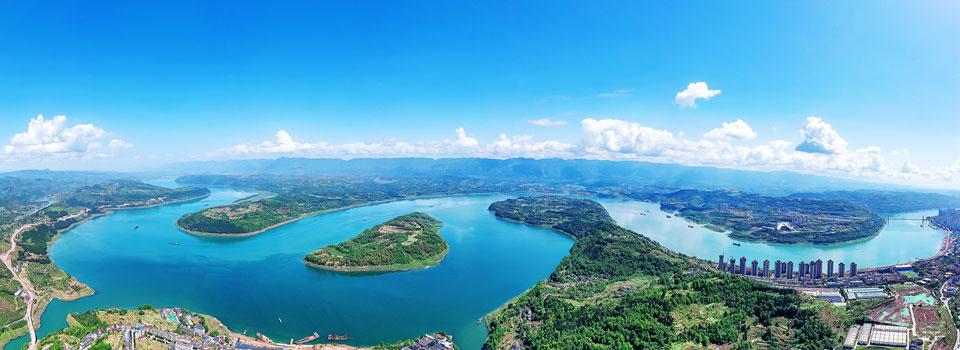
冉屋丘遗址位于皇华岛内最大的平坦台地上,该发掘区内清理揭露宋至明清时期的五组遗迹,其中,第一组宋代遗迹规模较大、保存较好,据其形制结构推测,可能为《忠州直隶州志》所载咸淳府知府常福庆所建“宏文院”。该建筑群由正殿、泮池、飞桥基座及景亭等部分组成,正殿为大型台基建筑,据磉墩可知面阔五间,当心间5.3米,泮池位于正殿西侧,平面略呈方形。飞桥基座位于正殿西侧,东与正殿当心间等宽,西侧内收。景亭位于水池南侧,正对水池方向。水池内靠位置另发现有方形柱础石三个,推测应与临水建筑有关。宏文院为“忠州设立书院之始”,其创建与南宋时期川渝地区特殊的“类省试制度”有密切关系,是战争背景下“士有处而学”故“斯文未绝”的真实写照。
The Ranwuqiu Site is located on the largest flat terrace within Huanghua Island. In this excavation area, five sets of relics from the Song dynasty to Ming-Qing dynasties have been cleaned up and revealed. Among them, the first set of relics from the Song dynasty is relatively large in scale and well-preserved. Based on its architectural structure, it is speculated that it may be the "Hongwen Academy" built by Chang Fuqing, the Xianchun Prefectural Governor mentioned in the Annals of the Directly Governed Sub-Prefecture Zhongzhou. Its architectural complex consists of the main hall, the Pan Pond, the fly-bridge pedestal, and pavilions. The main hall is a large platform building consisting of five bays, among which the central bay (dangxinjian) measures 5.3 meters in width according to measurement of the pillar bases. The Pan Pond is located on the west side of the main hall and has a slightly square-shaped floor plan. The fly-bridge pedestal is in the west of the main hall, with the same width as central bay of the main hall on the east side, and slightly recessed on the west side. Located on the south side of the pond, the pavilion is facing directly towards the pond. Three square column base stones were found near the water pool, indicating their possible connection with waterfront structures. Hongwen Academy has initiated the trend of "establishing academies in Zhongzhou". Its establishment is closely related to the special "provincial-level examination system" in the Sichuan-Chongqing region during the Southern Song Dynasty. It is a true portrayal of "scholars having a place to study" and "the preservation of culture despite war".
